Call us

Dec 04, 2025 Public lecures Events
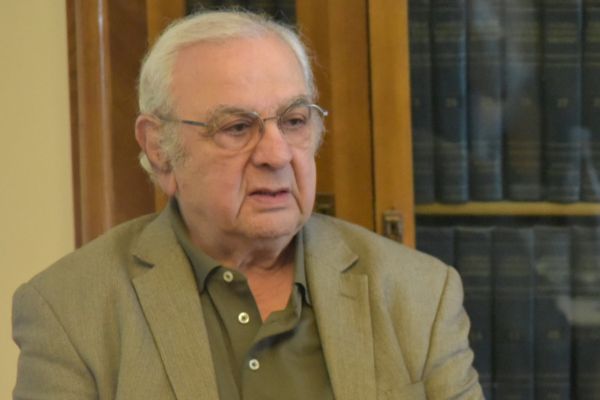
The National Library of Armenia hosted a public lecture by historian, public and political figure, diplomat, Doctor of Historical Sciences, Professor Jirayr Liparitian on the topic “Thoughts about the Diaspora?” During the lecture, Liparitian touched upon the historical reasons for the formation of the Armenian Diaspora, its stages of development, and current issues, suggesting that the Diaspora be perceived as a dynamic, multi-layered, and continuously changing reality. The speaker emphasized that the Diaspora is not a homogeneous phenomenon: it was formed in different eras, for various motives, and in different living conditions.
The formation of the Diaspora is based on a number of factors. In the Middle Ages and later eras, merchants, artisans, and scholars moved to new markets and cultural environments in search of economic opportunities and new fields of intellectual development. Over time, flows of those seeking work and prosperity left Armenia. The more tragic pages of the formation of the Diaspora are associated with repressions, wars, and state policies that forced large masses to leave their historical settlements. In particular, the massacres of the 19th and 20th centuries, the Armenian Genocide, and subsequent repressions created powerful waves of deportation.
It should not, however, be seen as the primary cause of the Armenian Diaspora's creation and continued existence. Identity and the preservation of Armenian identity have always been and will continue to be issues in the Diaspora, according to Liparitian. He underlined how Armenia's independence and worldwide recognition had profoundly altered the country and, in certain ways, eased the identity crisis for younger generations.
The speaker characterized the Diaspora as “a complex, living and evolving phenomenon.” In the Diaspora, communities that grow, specialize, and strengthen coexist, as do communities that fade and disappear over time. According to Liparitian, this is a natural process, conditioned by the gradual loss of language, assimilation, social integration, and demographic shifts.
He gave the example of the Armenian community in Cuba. There was a sizable, vibrant, and Armenian-speaking population there in the 1920s, but due to emigration and natural decline, just ten families remained ten years ago. As the speaker pointed out, there could not be any Armenian-speaking families left in Cuba today. According to Liparitian, this illustration demonstrates how some Diaspora centers evolve and change, taking on new roles and substance, while others quietly fade away without any disruptions.
Throughout the talk, he emphasized repeatedly that the Diaspora should not be viewed as a "finished" historical fact, but rather as a dynamic system that coexists with other cultures, languages, and political systems. According to Liparitian, it is normal for such a polycentric and open-structured union to experience simultaneous ups and downs, creation and destruction, consolidation and dissolution. At the end of the lecture, Zhirayr Liparityan responded to a range of questions, touching upon the prospects for the future of the Diaspora, relations with Armenia, strategies for preserving identity, as well as the need for unified pan-Armenian platforms and constructive cooperation. His analyses and examples once again emphasized that the Diaspora is not a legacy of the past, but a current, continuously transforming reality, the future of which largely depends on both the internal vitality of the Diaspora Armenian communities and the formation of mutually beneficial and long-term ties with Armenia.
 English