Call us

Aug 04, 2026 News
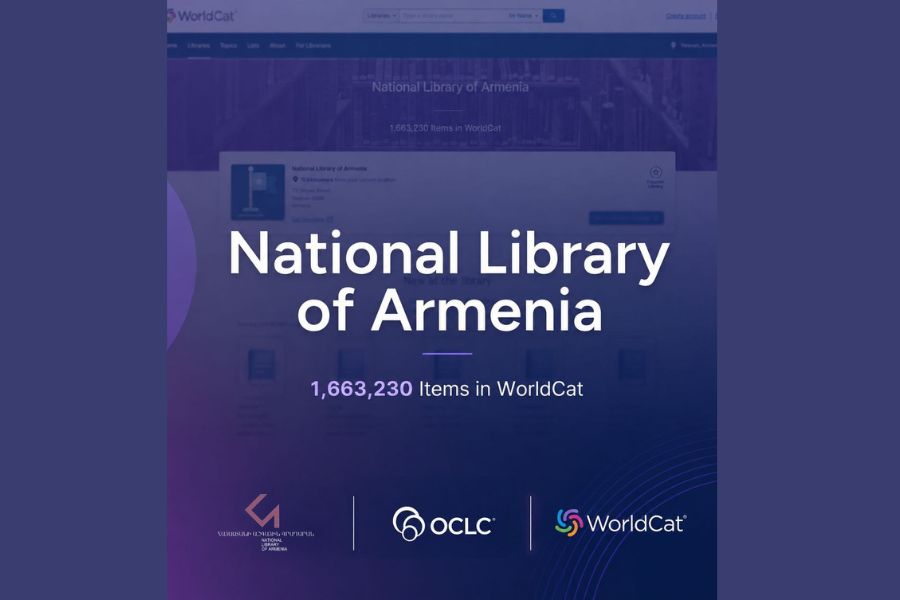
The National Library of Armenia has taken a significant step towards ensuring the international visibility and accessibility of Armenian written cultural heritage by joining the WorldCat global catalog: worldcat.org Millions of researchers, students, librarians, and readers worldwide can now access the extensive collections housed in Armenian libraries thanks to the availability of over 1,600,000 bibliographic records from the Armenian Library Union Catalog on WorldCat.
This achievement is the result of years of consistent work. The initiative was launched in November 2020, when the National Library of Armenia began large-scale work to bring each bibliographic record into line with international library standards. Standardization of records, improvement of author and subject controlled data, compliance with international standards, and quality assurance were implemented, thanks to which Armenian library data was fully integrated into the global library information environment.
Enrolling in WorldCat is crucial for Armenia's online and digital presence. The presence of Armenian on the Internet is greatly increased with the addition of over 1.6 million Armenian and non-Armenian bibliographic data to WorldCat, guaranteeing that the Armenian written legacy is available and searchable in the greatest library and academic archives in the world. The initiative is also of strategic importance for the international visibility of printed products published in Armenia. Books, periodicals, maps, musical editions, theses, and other types of Armenian publishing production become part of international search engines and library networks. This enables libraries, universities, scientific centers, and researchers around the world to discover and use materials published in Armenia, contributing to their international circulation, scholarly citations, and expansion of cultural impact.
Additionally, it is crucial to depict the printed legacy of the Soviet era. The National Library of Armenia's holdings of books, journals, and other publications from that era are valuable resources for learning about the region's history, science, education, and culture. Scholars from all over the world can more thoroughly examine the scientific, educational, and historical-cultural advancements of the Soviet era and Armenia's role in them because to their global accessibility.
Being a WorldCat member is beneficial:
• Increasing the international visibility of Armenia's cultural and scientific heritage,
• Developing Armenological studies and promoting new international research,
• Expanding the global visibility and use of Armenia's publishing products,
• Strengthening the digital presence and linguistic vitality of the Armenian language in global cyberspace,
• Deepening international library and scientific cooperation,
• Developing interlibrary exchange and information services,
• Strengthening Armenia's cultural diplomacy, presenting the country as a state with a rich written heritage and integrated into international information infrastructures.
Additionally, this program makes a significant contribution to the growth of Armenia's knowledge economy. Armenia's scientific, educational, and cultural influence grows, international collaboration is stimulated, and the country's cultural heritage is preserved and made more widely known when its intellectual output are integrated into international information networks. This is the first step. The National Library of Armenia will continue to expand the volume and quality of data represented in WorldCat, ensuring that Armenia's written heritage, the Armenian language, and intellectual products published in Armenia are more visible, accessible, and usable by the global scientific, educational, and cultural community.
Because WorldCat can be searched by Google and other international search engines, Armenian publications are more easily found on the worldwide web in addition to being available to library professionals. This highlights the initiative's influence on Armenia's cultural diplomacy and online presence. We thank the Ministry of Education, Science, Culture and Sports of the Republic of Armenia for supporting this initiative.
 English